 SUWANOSEJIMA
🇯🇵 Int'l Island Manga Artist, Ira
🇸🇬 Singapore PR
🌏 ADHD + ASD | IQ 115 | BMI 17.7
⛴️ Fastest to 500 islands in 3 years (World Record)
🙇 Japanese-to-English Google Translation. Apologies for any errors.
I am a hybrid of two clans that have lived in Okinawa and Kagoshima for generations.
I attended my Okinawan grandfather’s funeral.
My Okinawan lineage holds a tribal chieftain position within a certain region. It has an official name, but I won’t write it here.
Originally, the chieftain was my grandfather’s eldest son, but upon his death, the chieftain authority passes down to his younger brother.
It doesn’t pass to the eldest son’s spouse. Only males with the bloodline can inherit it.
Like the Emperor, Okinawa also has a rule where only males can inherit.
The system is set to end if only daughters are born.
This chieftain role comes with many physical constraints, binding the eldest son who inherits it generation after generation.
I was one who questioned this chieftain system built on the premise of “it’s fine if it ends.”
“If there’s a 50/50 chance the tradition gets abandoned, is it even necessary? If it’s a rule that needlessly binds people’s lives, let’s just stop it.”
I dislike irrational things.
The Chief’s Funeral
The funeral was held outdoors in a large tent. It wasn’t an indoor-style funeral like those on Honshu, Japan.
Since the clan chief had passed away, many people with the same surname from this area attended.
Most attendees were adults. Children were only occasionally seen.
He passed away in summer, but Okinawa is cooler than Tokyo or Osaka, so it wasn’t unbearably hot. Still, a line formed outside the tent, and some people waiting in line were holding parasols.
It’s surprising how many people share the same surname, even just in this area.
Okinawa has a declining birthrate too, so the numbers are probably shrinking yearly.
Attendees came throughout the day at the funeral venue. More seemed to come in the morning.
Fewer arrived during the hotter hours around 2 PM, and the numbers picked up again in the evening.
They bowed to us relatives, so we returned the bow.
We could go to the restroom during breaks.
My parents handled the venue preparations, so I don’t know much about that.
We have a Buddhist altar at home, but no mourners come to the house.
It’s only the funeral venue.
The funeral will be announced via the neighborhood broadcast system.
We notify relatives who don’t live in this area via LINE or similar means.
In Okinawa and remote islands, the custom of announcing funerals through neighborhood broadcasts continues to this day.
Even with today’s call for attendance, people seem to come unless it’s a major holiday period.
Funeral food
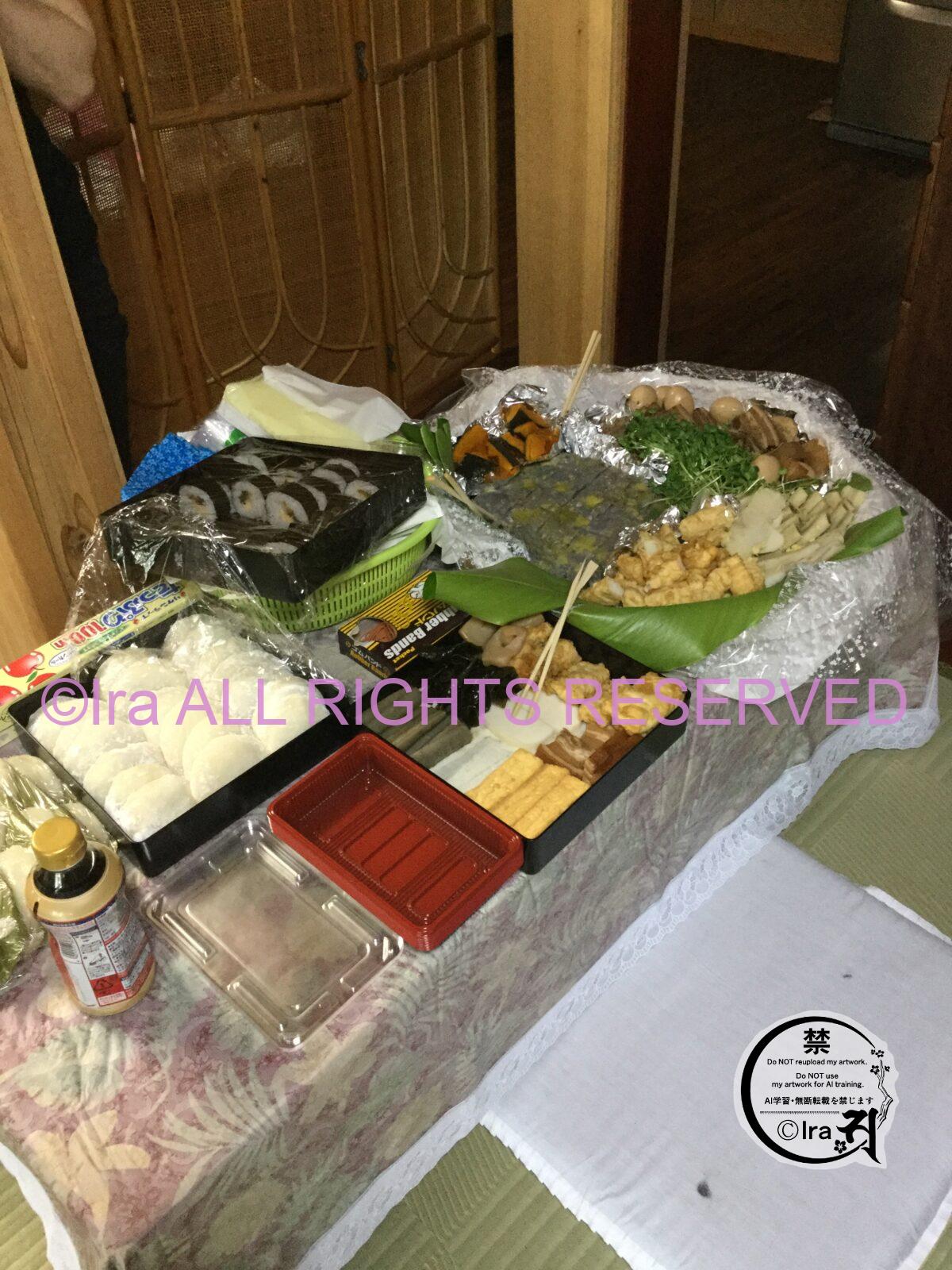
The food wasn’t catered; our relatives prepared it themselves. Since we have relatives in Okinawa who run a catering business, we handled it in-house. Other families might outsource it.
Here’s a photo showing the process of packing individual portions into plastic lunch boxes and securing them with rubber bands.
These weren’t distributed to all attendees. They were for relatives involved in organizing the event.
In Okinawa, we still commonly eat rice cakes like the ones in the photo. Even in midsummer, we have side dishes like this. It’s a strategy for high temperatures and humidity.
My spouse is Singaporean.
Singapore shares quite a bit of common culture with Taiwan and Okinawa.
The way funerals are conducted is different.
In Singapore, just like in Okinawa, it’s common to hold funerals all day long. I recall more attendees in the morning and evening. Like in Okinawa, people tend to avoid coming during the hottest part of the day.